Hold them. Mark them. Know when to sell.
Portfolio is the position-tracking and mark-to-market tool you use to value your book against today's thesis — not the one you had at entry.
Every position. One screen. Live numbers.
Your book of holdings, marked to market every quarter, with pooled IRR weighted by invested amount and DPI from real distributions — not paper projections.
- ·Every position with entry price, mark, gain/loss
- ·Pooled IRR across all holdings, weighted by invested amount
- ·DPI from real distributions you've recorded
- ·TVPI rolled up
- ·Sector and geographic concentration live
- ·Vintage breakdown — what's working, what isn't
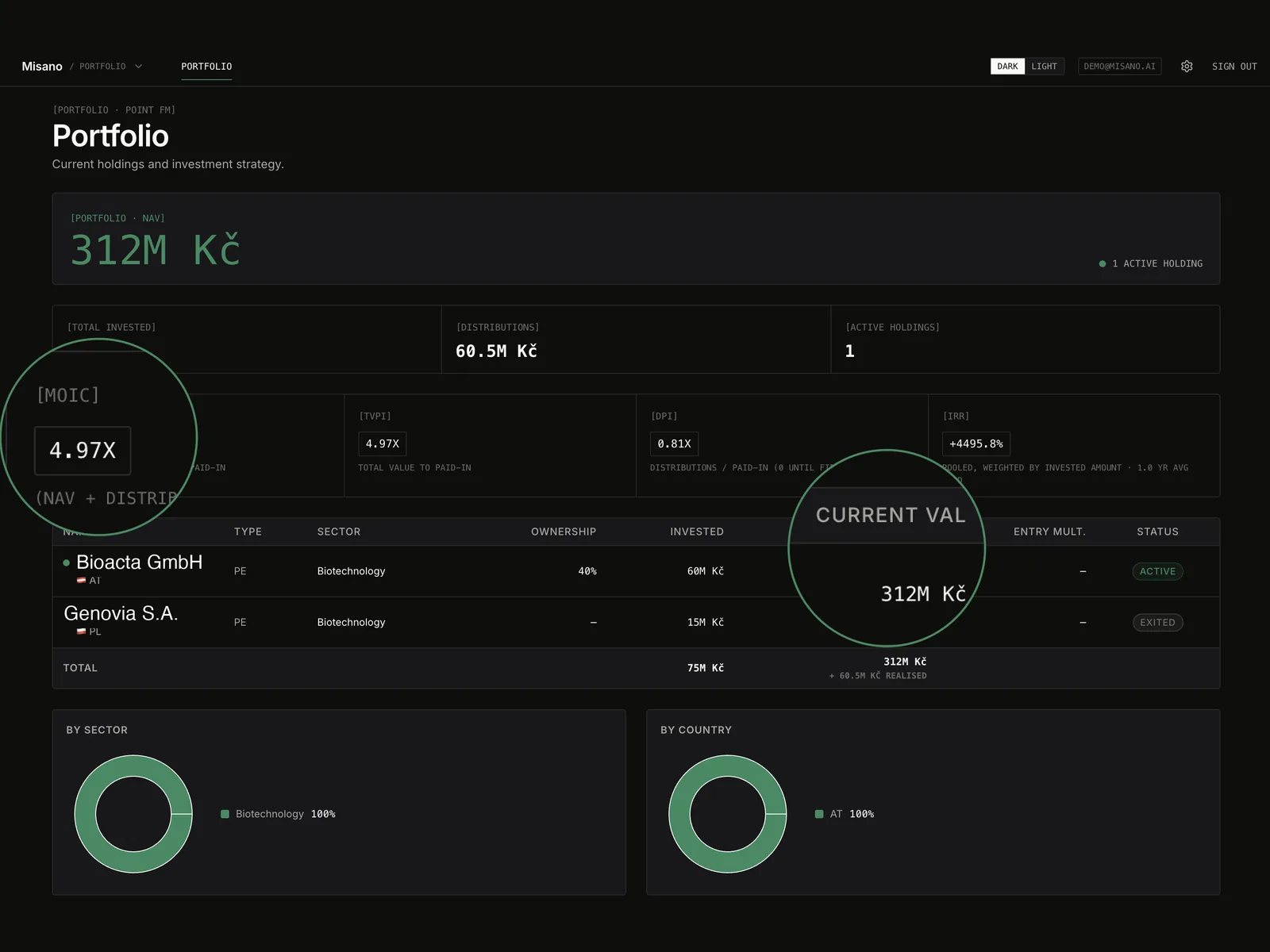
The book, in four numbers
Sample · LernioMost fund tracking is a quarterly LP letter and a spreadsheet someone updates the night before. Portfolio is the spreadsheet — but always current, always pulling from the same data your investors saw at entry. Consistency builds trust.
When the LP asks 'what's the book worth today,' you answer in three seconds, not three days.
Three ways to mark. One that's defensible.
Portfolio marks every position by the methodology that fits — last round, comparable transactions, or DCF — and shows which one was used and why.
Last round
early-stageMost common for early-stage. Misano flags it as last-round marking and stamps the round date. If the round is older than 18 months, it warns.
Comparable transactions
mid-marketFor mid-market positions. Misano pulls comparable transactions by sector and size. EV/Revenue and EV/EBITDA. Time-decay discount applied. Source transactions cited.
DCF
matureFor mature positions with consistent cash flow. Same DCF engine as Scout. WACC, terminal growth, exit multiple — all editable per position.
Each mark carries
- · Methodology badge
- · Date stamp
- · Source artefact (round doc, comp transactions, DCF inputs)
- · Auditor-ready footnote
When the LP asks 'how did you get to this mark,' your answer is a screen, not a story.
The thesis you bought at isn't the thesis you hold at.
Portfolio rescores every holding against your current strategy and current Knowledge Base — quarterly, or whenever you push an update. The position that scored 78 at entry might score 62 today. Or 91.
How it works
Same five dimensions as Scout. Same weights derived from your current strategy. Same Knowledge Base feeding back into the model. Difference: it runs on your holdings, not your pipeline.
What it tells you
- · Score evolution per position over time
- · Which dimensions moved — Market deteriorated, Moat strengthened
- · Whether the original investment thesis still holds
- · Or whether the position has quietly become a sell
Funds hold too long. Not from conviction, but because selling means admitting the thesis evolved. Misano turns that admission into a number, not a conversation. Numbers are easier to act on.
Keep track of your investments like a professional fund.
From €39/mo billed annually — 10 positions on Solo, up to 100 on Institutional. Mark-to-market, pooled IRR, real DPI. Cancel anytime on monthly.